Showing posts with label advice. Show all posts

Monday, January 5, 2015

Surviving an internship

After having completing several interships, the most recent being a year-long paid internship at a community newspaper, I have learned some important lessons that might help you along your way.

Never be bored. Always remember you are there to learn and gain as much experience as possible. If you are bored, ask to shadow someone or sit in on a meeting. Offer to help wherever you can. Having nothing to do is extremely unproductive.


Wearing shorts is never okay. Period.

Making mistakes is normal. As an intern it is quite possible that you're entering a situation where you have very little experience. It is therefore very normal to make mistakes. In fact, the biggest lessons you'll ever learn in the workplace are through making mistakes. Own your mistakes (admit when you are wrong and take responsibility for them), this demonstrates maturity and professionalism. Mistakes are okay, as long as you learn from them.

Don't think of yourself as an intern. You are just as entitled as any other staff members to be taken seriously, treated with respect and appreciated. However, this means you are also open to just as much criticism and responsibility as any other co-worker. It also means that you will be expected to perform and meet expectations just as much as any other staff member. My advice is to not use the fact that you are an intern as an excuse to get away with something, ever.

Stand up for yourself. Coffee runs and filing is to be expected in any internship. But it is not all you are there to do. You are there to learn. You are entitled to approach your manager or mentor and express any concerns that you may have and ask to be treated in a certain way. Being an intern does not mean you are beneath anyone in your office and you should be treated as such. If you ever feel like you are being taken advantage of, speak up.

Deep end and drowning. Take it from me, having the title 'intern' means that anything and everything is going to be dumped on your desk often with tight deadlines. It may sound cliche but the best way to learn is being thrown in the deep end and learning how to swim.

Email etiquette. Email is usually the most common form of communication in the workplace and it comes with a bunch of rules that may not apply when you're popping a quick message off to your mom.

  • Always include a subject. Emails without subjects are less likely to be opened.
  • Always use full sentences and check your spelling. 
  • Texting talk, abbreviations and replacing words with letters just will not fly.
  • Make sure you sign off properly by stating your name and position.

Wednesday, January 22, 2014

What to Take to University/College


This is the time of year (well at least in South Africa anyway) where endless crowds of students flock towards universities, colleges and other tertiary institutions for the first time in their lives to embark on their next – and perhaps their most exciting – chapter.

Many universities send out lists of things that you would generally need to buy or bring with you in order to survive the year. There are even some great websites that will help you out here. But I have put together a list of essentials that no one tells you that you will need, but that I can promise you that you will need along the way at some point:
  1. A torch/flashlight: Don’t just think that your shiny new Smartphone will provide you with adequate light when you’re alone in the dark. What if there’s a power cut and your battery is flat? And what if you have a test the following day that you have yet to study for? Trust me, no matter where you are in the world – but especially in South Africa where power cuts are a normal occurrence – you will be grateful for a torch. 
  2.  Highlighters: a ton of them! This is something that I can without a doubt guarantee you will need. And you will need a lot of them. This wonderful tool is useful in any learning environment, but particularly at varsity where the amount of content that you will be required to learn is exponential. And these sneaky little things have a habit of running dry at 2am when you’re desperately trying to cram an entire textbook into your cranium, so always make sure you have spares. 
  3. A lighter: This is a little trick that I picked up in my first year. Lighters are the best conversation
    starters. If you’re at a party, in a club or at an event of some sort, there will always be someone looking for a lighter (especially if you live in the tobacco capital of the world like I do). It’s an excellent way to get to meet new people and learn a little bit about them. Lighters are also pretty nifty little tools and help a lot in many situations. 
  4. A small first aid kit: this is something that you can either buy in its entirety, or put together yourself. Essentially you will need a few plasters/band aids, some antiseptic fluid or ointment and at least a bandage or two. Unidentified drunken injuries (UDIs) and a slip and fall on campus are almost inevitable at some point, it’s best to prepared. 
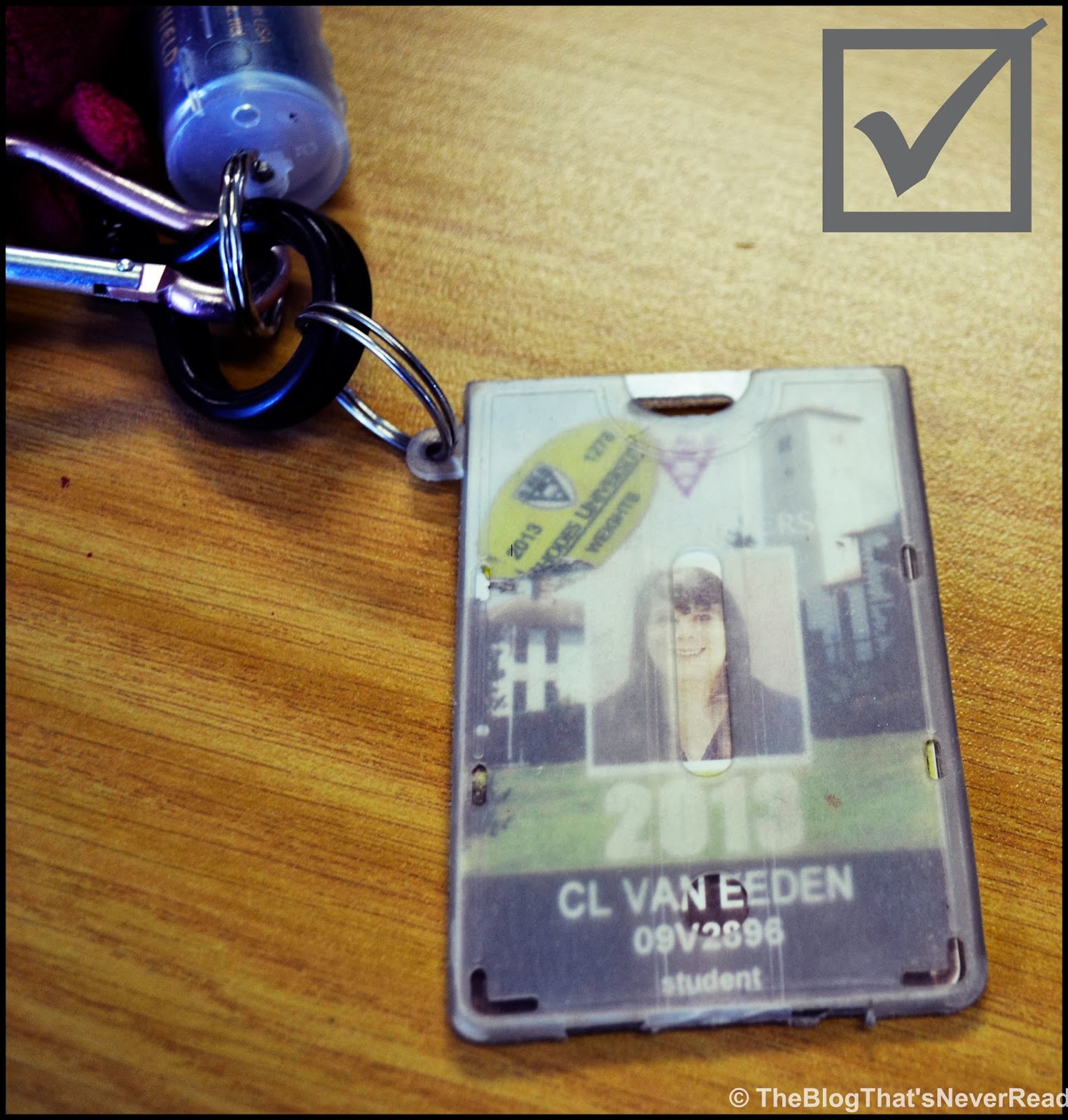
  5. A card holder and lanyard: Some universities supply lanyards and card
    holders as a part of their orientation packs, others don’t. But these two things can be total life savers. You will have a student identity card of some sort that you will most likely need to have on you at all times whilst on campus. These slippery pieces of plastic are incredibly easy to misplace or lose. If you keep yours in a plastic card holder that you can either attach to a bunch of keys or a lanyard that you keep around your neck or in your pocket/bag, you will be less likely to lose your student card. I have put together a list of things that you will definitely need at University/College if you are of the female variety, check it out!
If you have yet to stumble across a general list of things that you should take with you to University, here is a quick one that you can build onto:
  • Bed linen – it’s nice to have your own, even if they supply you with a set 
  • Your clothes, obviously 
  • Bath towels 
  • A kettle, mugs, spoons and tea/coffee (depending on your living situation) 
  • Pens, notebooks and files/folders 
  • A 2014 diary (to keep track of deadlines and test dates)

Thursday, February 14, 2013

A first year's guide to failing | How To

In South Africa, it is that time of year where the lucky 1 percent of our country is experiencing the start of a crucial life experience: their first year of University. As someone who has "been there, done that" I have some valuable tips that may help you in your (most probably unintentional) feat to fail your first year.


**WARNING: this post may contain dangerous amounts of sarcasm. Please proceed with caution.

Credit to Gabriella
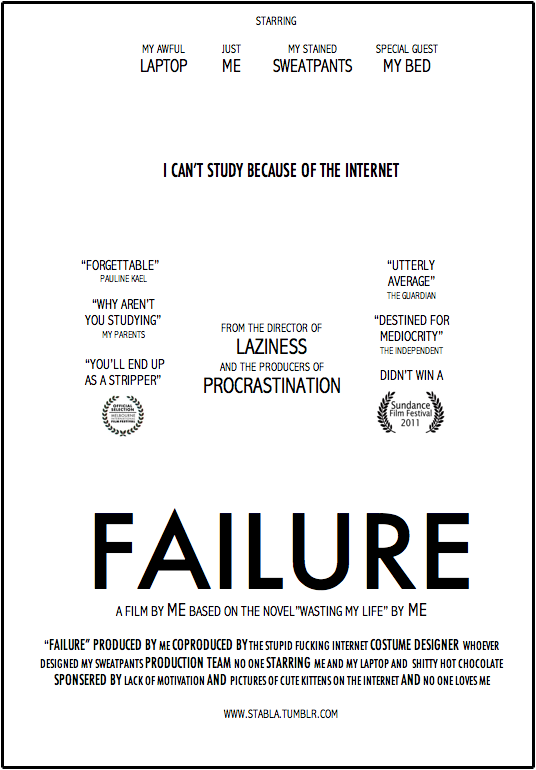
  1. Don’t go to lectures/classes. Rely solely on what’s in your store-bought textbook, on the internet or in your friend’s notes.
  2. If you do go to lectures/classes, try to sleep through them as much as possible. That way you’re catching up on enough sleep to complete steps 3 & 4
  3. Party every single Friday, Saturday and student special night.
  4. Stay up all night watching movies, TV or on tumblr. Don't be disciplined. Self-government is a pointless thing to learn anyway. 
  5. Get high a lot. And make friends with people who get high a lot.
  6. Get addicted to something that costs the majority (if not all) of your allowance.
  7. Only study the night before or even the morning of big tests and exams
  8. Never go the extra mile, only to the bare minimum. Meeting sub-minimum requirements is all that matters.
  9. Rely on that one really nice friend of yours to take notes for you in class and use them for their study notes too...don’t worry, they won’t drop you just before exams.
  10. Blame your crappy marks on everything and everyone but yourself. Being honest never gets you anywhere.
  11. Definitely don’t try to find a balance between academics and the rest of your life.
  12. Focus solely on how many days are left until vacation and how homesick you are.
  13. Occupy yourself with impressing the opposite sex. You need to spend at least 70% of your week doing this.
  14. Oh, wait! You need to spend at least 70% of your week wasted. Or high. Or both. Preferably both.
  15. Do not, under any circumstances, spend any amount of time on trying to grasp time management  prioritisation or goal setting.
  16. Mal-nourishment is fiiiine! You need the money for booze anyway.
  17. Do not motivate yourself. Ever. And don’t spend any time trying to figure out how to motivate yourself because, like I said, you never need to motivate yourself. And don’t befriend people who are self-motivated. Stay far away from them...they might just influence you.
  18. Never be proactive. Complacency is key. No one likes driven people anyway.
  19. Sleep around. As much as possible. STDs and STIs are so rare. And date rape is obsolete. And getting a reputation on campus will have no affect on your academics.
  20. And lastly, do not have the willingness to learn.


Monday, March 5, 2012

Advice for Tests | Advice

If you have a test coming up, especially if you have never written a test on a University/College level, here are some hints and tips that might help:

1) Prepare. Obviously. If you have not studied enough, chances are that you will not do well. However, paying/getting someone to write a test for you can result in you being excluded from Varsity. What is worse, failing a test or being excluded?

2) Try to get enough sleep the night before. It is better to get enough sleep so that you can concentrate, stay awake and access the things you already know, than to pull an all-nighter (and maybe know everything) but not be able to remember most of what you have studied because your brain is tired.

3) Take water rather than coffee into the test. Although coffee might wake you up, water will keep you hydrated and thinking clearer. Also, spilling coffee is worse than spilling water.

4) Use the loo before you get into the test venue.

5) Before you leave for the test, double check that you have all the necessary stationary. If you have a cold, make sure you have tissues. If you have a medical issue such as asthma, make sure you have the necessary emergency medication with you. If you are particularly stressed or nervous about the test, you may forget something really important - don't take it for granted.

6) Leave your cellphone at home. Unless you will need it after the test to get someone to fetch you etc. it is best to leave it out of the test venue entirely. Most Universities/Collages will penalize you heavily if your phone goes off or if you are seen with it. Rather don't take the risk.

7) Last, but not least, give yourself enough time to get to/find the venue and perhaps even use the facilities. Arriving late for a test is embarrassing, it might stress you out and hamper your ability to remember information and you might not even be allowed to write the test.

GOOD LUCK and STUDY HARD :)

Thursday, March 1, 2012

READ! | Advice

Read to prepare. Read ahead. Read to understand.

One of the most important lessons I have learned in my academic career is to DO YOUR READING. Most University/College subjects - particularly those within a Bachelor of Arts degree (Humanities) - require you to read a certain number of prescribed texts as well as do your own research on the topic or course. As much of a drag as it seems, the most helpful thing you can do is keep up with your reading. If you are required to read certain things in preparation for a lecture/seminar/tutorial, set aside some time the night before to do it. The more you read the faster you will be able to read and the quicker doing readings will take. 

Academic readings are not always overflowing with stimulating content. But they will most definitely enrich your understanding and help you engage with the topic in a more productive way rather than just pitching to lectures. Also, reading throughout the year means you will be a lot more prepared when exams roll around. Instead of spending hours of your study time getting through long readings. If you spend a little time each day reading, all you will have to do during exams is revise.

It also helps to highlight important points as you read (use a highlighter or underline with a pen) and, if you're feeling super enthusiastic, you can keep a notepad nearby to make a summary of important points to read as a part of your revision.

I'm off to read a research paper...

Wednesday, February 15, 2012

Announcement

I have decided to make some changes to my blog. A while ago a read an article (I can't remember where) about how to have a successful blog that will attract readers. One of the suggestions was that your blog should centre around a particular theme or topic, for example, fashion or photography rather than it just be a place where you write about your life as people may find this boring and it makes your blog less accessible on search engines.

I have been doing some soul-searching lately and I have realised that I have been through so much in my life. And each new experience, whether it be negative or positive, teaches me a new lesson. This may sound very cliche, but I am slowly realising that there is truth in the phrase "everything happens for a reason".

It has always irritated me when people have said that to me as a means of consoling me whilst I am going through something. At the time, it is very difficult to believe that this terrible thing that you are going through is actually meant to teach you some sort of important life lesson. But I find that once the storm has passed, I tend to look back in retrospect and realise what I learned (or was meant to learn) from that situation/experienced.

The point that I am trying to make is that I have learned many hard lessons in my lifetime. And whilst I do believe that you should learn your own lessons, it is helpful (and saves time) to learn from other people's mistakes and triumphs too. And so I am re-purpossing my blog as more of a place where I can share advice and suggestions with others. So stick around...