Showing posts with label university. Show all posts

Wednesday, January 22, 2014

What to Take to University/College


This is the time of year (well at least in South Africa anyway) where endless crowds of students flock towards universities, colleges and other tertiary institutions for the first time in their lives to embark on their next – and perhaps their most exciting – chapter.

Many universities send out lists of things that you would generally need to buy or bring with you in order to survive the year. There are even some great websites that will help you out here. But I have put together a list of essentials that no one tells you that you will need, but that I can promise you that you will need along the way at some point:
  1. A torch/flashlight: Don’t just think that your shiny new Smartphone will provide you with adequate light when you’re alone in the dark. What if there’s a power cut and your battery is flat? And what if you have a test the following day that you have yet to study for? Trust me, no matter where you are in the world – but especially in South Africa where power cuts are a normal occurrence – you will be grateful for a torch. 
  2.  Highlighters: a ton of them! This is something that I can without a doubt guarantee you will need. And you will need a lot of them. This wonderful tool is useful in any learning environment, but particularly at varsity where the amount of content that you will be required to learn is exponential. And these sneaky little things have a habit of running dry at 2am when you’re desperately trying to cram an entire textbook into your cranium, so always make sure you have spares. 
  3. A lighter: This is a little trick that I picked up in my first year. Lighters are the best conversation
    starters. If you’re at a party, in a club or at an event of some sort, there will always be someone looking for a lighter (especially if you live in the tobacco capital of the world like I do). It’s an excellent way to get to meet new people and learn a little bit about them. Lighters are also pretty nifty little tools and help a lot in many situations. 
  4. A small first aid kit: this is something that you can either buy in its entirety, or put together yourself. Essentially you will need a few plasters/band aids, some antiseptic fluid or ointment and at least a bandage or two. Unidentified drunken injuries (UDIs) and a slip and fall on campus are almost inevitable at some point, it’s best to prepared. 
  5. A card holder and lanyard: Some universities supply lanyards and card

    holders as a part of their orientation packs, others don’t. But these two things can be total life savers. You will have a student identity card of some sort that you will most likely need to have on you at all times whilst on campus. These slippery pieces of plastic are incredibly easy to misplace or lose. If you keep yours in a plastic card holder that you can either attach to a bunch of keys or a lanyard that you keep around your neck or in your pocket/bag, you will be less likely to lose your student card. I have put together a list of things that you will definitely need at University/College if you are of the female variety, check it out!
If you have yet to stumble across a general list of things that you should take with you to University, here is a quick one that you can build onto:
  • Bed linen – it’s nice to have your own, even if they supply you with a set 
  • Your clothes, obviously 
  • Bath towels 
  • A kettle, mugs, spoons and tea/coffee (depending on your living situation) 
  • Pens, notebooks and files/folders 
  • A 2014 diary (to keep track of deadlines and test dates)

Monday, March 4, 2013

Depression Checklist for Students | Advice


Sometimes it's tricky to figure out if you're feeling sad or if you're genuinely depressed. Run through the checklist below, it may help. This is something I complied myself, it is not by any means a professional document.

1) Are you not feeling like yourself?
2) As students, we generally don’t have the healthiest eating habits, but have your eating habits changed drastically? Are you eating a lot more or a lot less than usual?
3) Do you find yourself either over-reacting to the smallest things or feeling numb when you should be reacting to big things?
4) Are you lacking motivation lately? Are you finding it difficult to get out of bed in the morning or battling to find the motivation to get things done?
5) Are you sleeping more than usual or than your should be? Or are you finding it difficult to fall asleep or stay asleep? Do the words "I'm too depressed to sleep" make sense to you?
6) Do consequences not matter to you anymore? In other words, do you care if you miss an important class or not?
7) Are you more homesick than usual? Most students who are studying away from home experience homesickness at some point and some more than others, but are you missing home or your parents a lot more?
8) Do you feel like other people won’t/don’t understand what you’re feeling?
9) Do you feel isolated and alone?
10) Do you sometimes feel like you just can't do this thing called life?
11) Are you turning to alcohol, drugs or other substances to help you to forget about how you’re feeling or numb yourself?

If you've answered yes to a lot of the things above, you might be experiencing depression. It may be serious or it may be temporary. Depression can be caused by so many things and it’s important to know that a lot people suffer from depression every day...your problem is not unusual and you are not alone - as cliche as that may sound.


So what can you do?


  • Fight! Don’t give in. I know it’s easier said than done, but find the strength within yourself to hold on.
  • Seek help. Whether it be making an appointment at your campus counselling centre or seeing a private psychologist, there is help out there! You may not think that therapy is for you or you may be totally opposed to it. That’s okay too.
  • Talk to someone. If you’re not into  going for some therapy, try to find a friend, family member or even a teacher to talk to. Sometimes opening up to someone and being heard can help in the biggest way. And don’t give up if you have a bad experience the first time you talk to someone.
  • Look for support. Actively searching for support and information on online forums and communities can make you feel a whole lot better. MDJunction is a really great place to find support!
  • Get active! Getting some exercise can do you a world of good. Getting those endorphins pumping will immediately feel happier. Go for a walk or a swim, play a game of tennis...anything that gets you moving and out of the confines of your bedroom.
  • Make a list of things that you usually make you happy or that made you happy when you were a kid and do them! Whether it be baking, building puzzles, going to the beach, going out dancing, hiking, gardening, shopping, painting, volunteering etc.


Thursday, February 14, 2013

A first year's guide to failing | How To

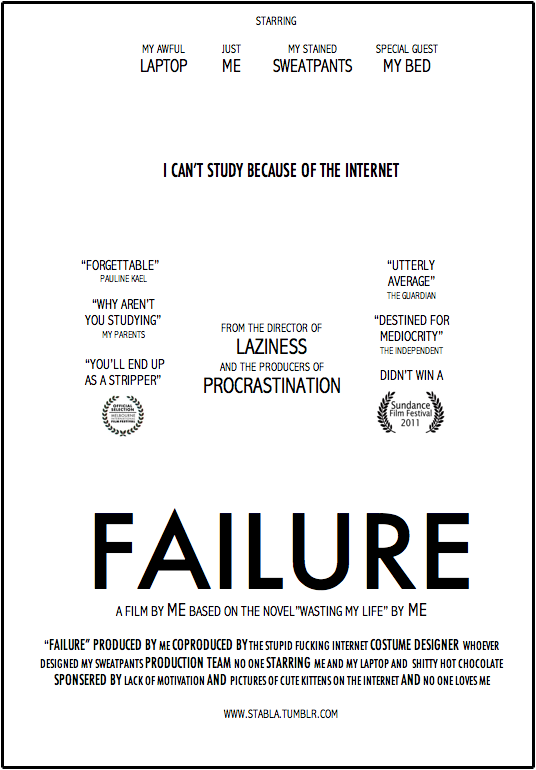
In South Africa, it is that time of year where the lucky 1 percent of our country is experiencing the start of a crucial life experience: their first year of University. As someone who has "been there, done that" I have some valuable tips that may help you in your (most probably unintentional) feat to fail your first year.


**WARNING: this post may contain dangerous amounts of sarcasm. Please proceed with caution.

Credit to Gabriella
  1. Don’t go to lectures/classes. Rely solely on what’s in your store-bought textbook, on the internet or in your friend’s notes.
  2. If you do go to lectures/classes, try to sleep through them as much as possible. That way you’re catching up on enough sleep to complete steps 3 & 4
  3. Party every single Friday, Saturday and student special night.
  4. Stay up all night watching movies, TV or on tumblr. Don't be disciplined. Self-government is a pointless thing to learn anyway. 
  5. Get high a lot. And make friends with people who get high a lot.
  6. Get addicted to something that costs the majority (if not all) of your allowance.
  7. Only study the night before or even the morning of big tests and exams
  8. Never go the extra mile, only to the bare minimum. Meeting sub-minimum requirements is all that matters.
  9. Rely on that one really nice friend of yours to take notes for you in class and use them for their study notes too...don’t worry, they won’t drop you just before exams.
  10. Blame your crappy marks on everything and everyone but yourself. Being honest never gets you anywhere.
  11. Definitely don’t try to find a balance between academics and the rest of your life.
  12. Focus solely on how many days are left until vacation and how homesick you are.
  13. Occupy yourself with impressing the opposite sex. You need to spend at least 70% of your week doing this.
  14. Oh, wait! You need to spend at least 70% of your week wasted. Or high. Or both. Preferably both.
  15. Do not, under any circumstances, spend any amount of time on trying to grasp time management  prioritisation or goal setting.
  16. Mal-nourishment is fiiiine! You need the money for booze anyway.
  17. Do not motivate yourself. Ever. And don’t spend any time trying to figure out how to motivate yourself because, like I said, you never need to motivate yourself. And don’t befriend people who are self-motivated. Stay far away from them...they might just influence you.
  18. Never be proactive. Complacency is key. No one likes driven people anyway.
  19. Sleep around. As much as possible. STDs and STIs are so rare. And date rape is obsolete. And getting a reputation on campus will have no affect on your academics.
  20. And lastly, do not have the willingness to learn.


Monday, November 26, 2012

5 Tips for Kicking Exam Stress' Butt | Advice

Most institutions place a huge emphasis on exams. This puts students under an immense amount of pressure which more than likely amounts to a great deal of stress. Stress is one of the most counterproductive things when it comes to exams: it prevents one from thinking clearly and retaining information. It results in constant fatigue and people often develop unhealthy habits as a result of stress. As someone who gets really stressed when it comes to exams, here are my tips to deal with and even combat exam stress:


1) Get enough sleep. Establish a set bedtime and make sure you stick to it and make sure you get a full 8 hours (if not more). Both your brain and your body need sleep in order to process and retain information, to cope with stress and to help you concentrate.
2) Exercise. Although working out or playing a sport does cut into your study time, setting aside an hour a day to get moving will actually benefit you more than studying for that hour. The reason being is that it floods your body with oxygen and gets your blood pumping. When exercising you can get all your frustration out and it helps hugely with keeping stress levels at bay.

3) Avoid stressful people. As mentioned in my previous post about exams, staying away from people who stress a lot is just as important as avoiding negative people. People who naturally stress a lot will have an influence on the way you function. Their stress levels will rub off on you.

4) Stay healthy. One tends to pick on a lot of sugary and unhealthy food during exams - mostly because of stress and the need for energy. Treat your body respectfully and it will return the favour. Try to eat at least one proper meal a day that includes a high dose of protein and a load of different veggies. Eating balanced meals will help your body cope with stress and keep you feeling healthy.

5) It's mind over matter: think your way out of stress. If you stress at a particular time during exams (e.g. the night before an exam , the day of or even right at the beginning of your studying) then make sure you prepare yourself to mentally combat your own stress. This might sound really wishy-washy, but you do have the power to control your own thoughts. When stressful thoughts cross your mind, distract yourself, think about calming things and convince yourself - even if it may not be the truth - that you are well-prepared and that you have more than enough time to get everything into your head.

GOOD LUCK!!!

Monday, June 18, 2012

How to do well in College/University | Advice

It's quite straightforward really, but harder said than I know...

1) Attend all your lectures

As much as you think they might be useless or boring. Your lecturer will notice that you are a regular and might keep that in mind when marking your assignments/exams and they are the majority of what your exams are based on.

2) Attend all tutorials or extra classes

Sometimes just showing face can get you far in life. And you never know when you might just be rewarded for your efforts!

3) Ask for help - but prove that you can be helped

Although asking for help can be embarassing sometimes, there are going to be things that you don't understand or can't quite grasp. This does not mean you are stupid. Often asking for help shows that you are invested and that you are willing to go the extra mile. Ask a friend who takes the same class, a tutor or your lecturer. No question is a stupid question, and if anyone implies that it is, report them. It is always a good idea to go into whatever meeting you've made to get help prepared. Make sure you know exactly what you are going to ask and be able to prove that you have already tried to help yourself by doing research, extra readings and so on.

4) Hand your work in on time

Handing work in late purely because of poor time management will certainly jeapordise your marks.

5) Work consistently

Keep up with your work during term so that you don't spend all your time trying to catch up work an understand things that you haven't gotten around to yet when it is actually time to be studying. When exams come around you want to be spending time on revising what you already know.

6) Go the extra mile

If there are assignments that you can do for extra credit or if your lecturer has recommended extra readings - do them! Always strive to better yourself and build upon what you already know.

Wednesday, June 6, 2012

A College/University Student's Guide To Surviving Exams | How To

I have officially survived 3 years of University level exams and I'm about to go in for the 4th year. I have learned a lot along the way. This advice is not the usual: exercise, eat healthily etc. etc. That doesn't necessarily work for everyone. But here are some things that I have found to really help:


1) Drink PLENTY of water. 
They say 8 glasses per day. They also say 1 glass per 10kgs that you weigh. My opinion is drink as much as you can handle. If your bladder is anything like mine, you will need the bathroom pretty often. But keep in mind that it is flushing out all those nasty toxins that get in the way of your brain absorbing information. Also, for those of you who write exams in the middle of Summer, it's important to keep hydrated.

2) Stay away from people who will bring you down.
When you're studying (or cramming...let's be realistic), you want to stay as self-motivated as possible. You also want to feel confident in your own knowledge and abilities. Being around people who complain and are mostly negative about exams will not help you. Rather surround yourself with people who are willing to work just as hard as you are. That way you will have positive influences around you to guide you when you are feeling discouraged. When people are going through things together, they tend to adopt a common attitude.

3) Take a break after every exam.
Even if your exam timetable sucks and you have all your subjects in a row, it really helps to take a break after every paper. After sitting an exam (whether it be an hour long or 5 hours long), your brain, body and even your soul needs time to recouperate before you hit the books again. Most of the time I would recommend having a decent nap. But if you are too scared that you won't wake up fresh enough to carry on studying, do something that requires little energy. If you have 2 exams in the same day, go for a quick walk or have some lunch etc.

4) Always set more than one alarm!
Experience has taught me that even if you are the most responsible person in the world when it comes to exams, there is always the chance that something goes wrong. If you usually use your alarm on your phone, make sure that it is fully charged before you hit the sack. BUT, do yourself a favour and invest in a good old-fashioned alarm clock (they are not very expensive these days) that you can keep at your bedside. At least you will be gaurenteed to wake up. You don't ever want to be in a position where you have to explain to your Head of Department that you slept through your exam.

5) If you are addicted to something that helps you procrastinate, get someone to keep it from you during exams.
If you're anything like me, you can sit for hours watching endless YouTube videos and playing Tetris on Facebook. If you find yourself spending too much time doing these things when you should actually be settling down to study, get a friend to keep your laptop for you during the time that you have set aside to study. I'm not saying starve yourself of your luxuries. But get to know your own habits and identify where you waste the most of your time.

Monday, May 14, 2012

How to Write an Academic Essay | How To

Now that I am in my 4th year at varsity, I have realised that writing essays is no easy task - no matter how many of them you write. Each one is a new challenge and requires different techniques in order to answer the question or cover the topic effectively. Of course each Department/Faculty/subject will require different formats or styles of writing, but here are some general hints and tips that might help to guide you in your writing.

1) Make sure that you fully understand the task. 

In other words, make sure you know what the word count/page count should be, when it is due, what style of referencing is required and so on.

2) Read the question or topic numerous times.

...even if it is really short. Often people write entire essays without having answered the question or topic at all because they haven't read and understood the question properly. If there are parts of the question or words that you do not understand, Google them or speak to your lecturer or tutor for clarification. 

3) Breakdown your question. 

The longer you take a class/subject, the more complex the questions become. If there are numerous things which you need to compare, contrast, discuss or analyse and if you have sub-topics which you need to include then divide your question up (in point form) accordingly so that you do enough research to cover each point.

3) Work backwards! 

This is a technique that I only began using this year, but it works so well and helps you manage your time efficiently so that you don't miss the deadline or hand in something that isn't finished. How this works is you write down everything you need to do for the essay from last to first. So for example, the last thing you will need to do is submit it/hand it in, the second last is print it, the third last will be to proof read and edit, the fourth last is your bibliography and so on right up until the first thing which will be to choose your topic or to begin researching it. Then you write it out in order (from first to last) and divide it up into days. So you say  on Monday I want to choose my topic and begin researching it. On Tuesday I want to get books out of the library and read them. On Wednesday I want to finish reading the books and then get journal articles and so on. Make it into a checklist so that you can make sure you have completed your tasks towards the essay each day and if you don't finish what you have planned for that day then you can move it to the next day.

**NOTE:  For a lot of people (I am one of them), the pressure of leaving things until the last minute actually means that they will produce of a higher standard, but even if this is the case, plan backwards so that you at least have all your research done and you are ready to write at the last minute. You don't want to still be looking for information to write about the night before!

4) Do your reading.

For me, this is what takes the longest when writing an essay. Once you've read everything you need to write about then writing flows quickly. If your writing takes you longer than it does for you to read, then allot more time in your backwards planning for writing rather than reading. It depends on how you work.

5) Plan your essay. 

If you have read sufficiently, your planning will be easy because you will already know what you want to say. Lay your planning out in headings and then include points underneath, for example:
  • Introduction
          - Introduce topic and lay out aims for essay
          - Introduce argument
          - Define problem
  • First Paragraph: Social Theory
          - Define theory
          - Explain theory
          - Place theory in context
          - Apply theory to case study.

I  never used to plan my essays and my thoughts an arguments would never flow properly because my ideas were all over the place.

6) Start writing. 

Make sure you stick to your headings. If you are not allowed to include headings within your essay, delete them in your editing process. They help you to know where you are in the essay - especially if you want to add points to it later.

7) If you get stuck, take a break.

Do something completely unrelated and then come back. This way it will be easier for you to notice mistakes and tighten up your points.

8) PROOF READ! 

I cannot emphasise proofreading enough! Once you have completed your essay, read over it a few times (take a break before you do this). In most cases you will get marks deducted for sloppy presentation and formatting, poor spelling and grammar etc. It does not take long and it will help you in the long run. 

And you're done! :)