Monday, March 4, 2013

Depression Checklist for Students | Advice


Sometimes it's tricky to figure out if you're feeling sad or if you're genuinely depressed. Run through the checklist below, it may help. This is something I complied myself, it is not by any means a professional document.

1) Are you not feeling like yourself?
2) As students, we generally don’t have the healthiest eating habits, but have your eating habits changed drastically? Are you eating a lot more or a lot less than usual?
3) Do you find yourself either over-reacting to the smallest things or feeling numb when you should be reacting to big things?
4) Are you lacking motivation lately? Are you finding it difficult to get out of bed in the morning or battling to find the motivation to get things done?
5) Are you sleeping more than usual or than your should be? Or are you finding it difficult to fall asleep or stay asleep? Do the words "I'm too depressed to sleep" make sense to you?
6) Do consequences not matter to you anymore? In other words, do you care if you miss an important class or not?
7) Are you more homesick than usual? Most students who are studying away from home experience homesickness at some point and some more than others, but are you missing home or your parents a lot more?
8) Do you feel like other people won’t/don’t understand what you’re feeling?
9) Do you feel isolated and alone?
10) Do you sometimes feel like you just can't do this thing called life?
11) Are you turning to alcohol, drugs or other substances to help you to forget about how you’re feeling or numb yourself?

If you've answered yes to a lot of the things above, you might be experiencing depression. It may be serious or it may be temporary. Depression can be caused by so many things and it’s important to know that a lot people suffer from depression every day...your problem is not unusual and you are not alone - as cliche as that may sound.


So what can you do?


  • Fight! Don’t give in. I know it’s easier said than done, but find the strength within yourself to hold on.
  • Seek help. Whether it be making an appointment at your campus counselling centre or seeing a private psychologist, there is help out there! You may not think that therapy is for you or you may be totally opposed to it. That’s okay too.
  • Talk to someone. If you’re not into  going for some therapy, try to find a friend, family member or even a teacher to talk to. Sometimes opening up to someone and being heard can help in the biggest way. And don’t give up if you have a bad experience the first time you talk to someone.
  • Look for support. Actively searching for support and information on online forums and communities can make you feel a whole lot better. MDJunction is a really great place to find support!
  • Get active! Getting some exercise can do you a world of good. Getting those endorphins pumping will immediately feel happier. Go for a walk or a swim, play a game of tennis...anything that gets you moving and out of the confines of your bedroom.
  • Make a list of things that you usually make you happy or that made you happy when you were a kid and do them! Whether it be baking, building puzzles, going to the beach, going out dancing, hiking, gardening, shopping, painting, volunteering etc.



Thursday, February 14, 2013

A first year's guide to failing | How To

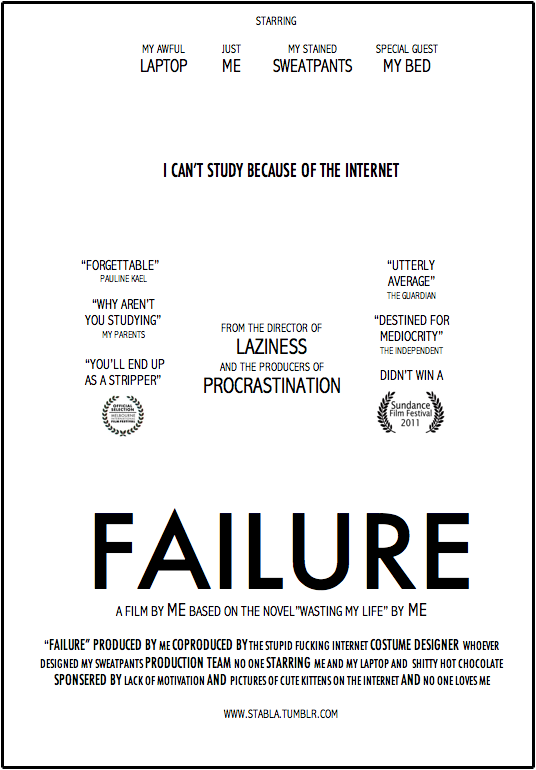
In South Africa, it is that time of year where the lucky 1 percent of our country is experiencing the start of a crucial life experience: their first year of University. As someone who has "been there, done that" I have some valuable tips that may help you in your (most probably unintentional) feat to fail your first year.


**WARNING: this post may contain dangerous amounts of sarcasm. Please proceed with caution.

Credit to Gabriella
  1. Don’t go to lectures/classes. Rely solely on what’s in your store-bought textbook, on the internet or in your friend’s notes.
  2. If you do go to lectures/classes, try to sleep through them as much as possible. That way you’re catching up on enough sleep to complete steps 3 & 4
  3. Party every single Friday, Saturday and student special night.
  4. Stay up all night watching movies, TV or on tumblr. Don't be disciplined. Self-government is a pointless thing to learn anyway. 
  5. Get high a lot. And make friends with people who get high a lot.
  6. Get addicted to something that costs the majority (if not all) of your allowance.
  7. Only study the night before or even the morning of big tests and exams
  8. Never go the extra mile, only to the bare minimum. Meeting sub-minimum requirements is all that matters.
  9. Rely on that one really nice friend of yours to take notes for you in class and use them for their study notes too...don’t worry, they won’t drop you just before exams.
  10. Blame your crappy marks on everything and everyone but yourself. Being honest never gets you anywhere.
  11. Definitely don’t try to find a balance between academics and the rest of your life.
  12. Focus solely on how many days are left until vacation and how homesick you are.
  13. Occupy yourself with impressing the opposite sex. You need to spend at least 70% of your week doing this.
  14. Oh, wait! You need to spend at least 70% of your week wasted. Or high. Or both. Preferably both.
  15. Do not, under any circumstances, spend any amount of time on trying to grasp time management  prioritisation or goal setting.
  16. Mal-nourishment is fiiiine! You need the money for booze anyway.
  17. Do not motivate yourself. Ever. And don’t spend any time trying to figure out how to motivate yourself because, like I said, you never need to motivate yourself. And don’t befriend people who are self-motivated. Stay far away from them...they might just influence you.
  18. Never be proactive. Complacency is key. No one likes driven people anyway.
  19. Sleep around. As much as possible. STDs and STIs are so rare. And date rape is obsolete. And getting a reputation on campus will have no affect on your academics.
  20. And lastly, do not have the willingness to learn.


Sunday, January 27, 2013

How to Bleach Your Nails | How To


Often using cheap nail polish (which is all I use), wearing false nails or working with food lead to yellow nails. A lot of people choose to carry on painting the nails so that the yellow isn't visible but I have found that the best thing to do is to bleach them first and get them back to their healthy colour before painting them again. Here are a few ways that you can try to bleach your nails:

Lemon:
Cut a ripe lemon into wedges and rub them on your nail bed for about 5-10 minutes. If you have cracked or raw cuticles, try to avoid getting the lemon juice on them as it will sting like crazy! If you don’t have fresh lemons you can use lemon juice in hot water and soak your nails for about 10 minutes. I find that fresh lemon works best.


Whitening Toothpaste:
Coat each nail with a thick layer of whitening toothpaste and leave it on until it dries. Then take a nail brush and some hot water and scrub it off.


Clean your house:
This may seem like an arbitrary concept, but the next time you’re cleaning or doing the dishes, leave the rubber gloves off. The bleach in your cleaning products will help to lift the stains. But be careful, household cleaning products can also weaken your nails and damage your skin – so don’t overdo it!