Monday, January 12, 2015

It's not just an email, bruh

A random introduction

Up until quite recently my blog has been a collection of university-related tips and advice as well as things I've learned along the way. Now that I have left the academic life behind for now (two degrees obtained, booyah!), I was faced with somewhat of a conundrum. Do I use the five years of university experience to continue to write posts about all things college related? Or do I pack my blog up and take it with me on this new chapter in my life and adapt it along the way?

I have decided to go with the latter.

So, having been in the real life working world for a little over a year now, I have learned some pretty tough lessons. And if one person can learn from my mistakes, then I'm happy.

The stuff you actually care about

Something you'll need to know stuff about quite early on in the working world
is email etiquette. Email has become the most common form of communication in pretty much all fields of work, so it's best you refine your emailing abilities as quickly as possible. Here are my top tips:

  • Always include a subject. Emails without a subject line are far less likely to be opened, let alone read. Try to summarise the topic of your email into a maximum of five words. 
  • Always greet the person, even if you've just seen them. Just jumping right into the content of your email isn't really professional.
  • Sign off properly. Ask your IT or graphic design department to create an email signature for you to include at the end of your emails. Make sure that you end the message properly using words such as 'kind regards' followed by your full name, your position and the name of the company that you work for.
  • Keep it as succinct as you can. Long paragraphs are difficult to read on a screen - especially if it's a small one, you never know when someone might open your email on their phone - and the reader can get bored or distracted pretty easily. Rather use short paragraphs broken up into bite-size chunks.
  • Learn how to spell. I cannot emphasise this one enough. Even the most perfect people in the world make spelling mistake, don't think you can get away without running a spell check. You can even do a brief read-over if you're sending a particularly important email.
  • Use full sentences and proper punctuation. Text-speak is not appropriate at all.
  • If you're anything like me, you'll tell recipients that there are things attached to an email but you don't attach the darn things! A good habit to get into is to attach the item/s to the email before you actually write it.

Monday, January 5, 2015

Surviving an internship

After having completing several interships, the most recent being a year-long paid internship at a community newspaper, I have learned some important lessons that might help you along your way.

Never be bored. Always remember you are there to learn and gain as much experience as possible. If you are bored, ask to shadow someone or sit in on a meeting. Offer to help wherever you can. Having nothing to do is extremely unproductive.


Wearing shorts is never okay. Period.

Making mistakes is normal. As an intern it is quite possible that you're entering a situation where you have very little experience. It is therefore very normal to make mistakes. In fact, the biggest lessons you'll ever learn in the workplace are through making mistakes. Own your mistakes (admit when you are wrong and take responsibility for them), this demonstrates maturity and professionalism. Mistakes are okay, as long as you learn from them.

Don't think of yourself as an intern. You are just as entitled as any other staff members to be taken seriously, treated with respect and appreciated. However, this means you are also open to just as much criticism and responsibility as any other co-worker. It also means that you will be expected to perform and meet expectations just as much as any other staff member. My advice is to not use the fact that you are an intern as an excuse to get away with something, ever.

Stand up for yourself. Coffee runs and filing is to be expected in any internship. But it is not all you are there to do. You are there to learn. You are entitled to approach your manager or mentor and express any concerns that you may have and ask to be treated in a certain way. Being an intern does not mean you are beneath anyone in your office and you should be treated as such. If you ever feel like you are being taken advantage of, speak up.

Deep end and drowning. Take it from me, having the title 'intern' means that anything and everything is going to be dumped on your desk often with tight deadlines. It may sound cliche but the best way to learn is being thrown in the deep end and learning how to swim.

Email etiquette. Email is usually the most common form of communication in the workplace and it comes with a bunch of rules that may not apply when you're popping a quick message off to your mom.

  • Always include a subject. Emails without subjects are less likely to be opened.
  • Always use full sentences and check your spelling. 
  • Texting talk, abbreviations and replacing words with letters just will not fly.
  • Make sure you sign off properly by stating your name and position.

Thursday, July 31, 2014

Blog Binging

I'm super excited about this blog post, mostly because I have been threatening to write it for so long:

I love blogging, and although I most definitely don't post often enough, I am deeply immersed in the blogosphere (this is about to become a trademark, no stealing). I collect blogs like some people collect shoes and honestly, it is often the highlight of my day when one of the blogs I live announce a new post.

There is also nothing more satisfying than lying on the couch in double-chin mode binging on some gem-ofa blog's "view older posts".

I have several friends who maintain stunning blogs. And although my news feeds across my social media sites are flooded with new blog posts on a daily basis, what excites me the most is when one of my friends posts something new. It almost makes reading their blogs ten times more exciting because you know the person.

Whether it be Dale's divine splashes of creativity, Zola's refreshingly frank epiphanies or Sabu's classically classy insights, when their stuff goes live I'm brimming with excitement.


These lovely ladies inspire me on a daily basis with their superior writing and uber creative concepts. Of course there are many more friends/acquaintances whose blogs I could shed some spotlight on, but these three are top of the log for me.

There's nothing like a good cup of coffee, a fresh bran muffin and a mind-blowing blog post to get your day going!

Thursday, May 29, 2014

Alternatives to self-harming - there is light at the end of the tunnel!

TRIGGER WARNING: Self-harm

A popular TV hit series in the 90s - and one of my all-time favourite shows - 7th Heaven has an episode (Season 3, episode 3) where the family's middle child discovers that her best friend Nicole is a self-harmer. But I believe it was as common then as it is now. Think about it, alcoholism has always been there, but there was once a time where there was very little awareness about it.
aired again where I live and this episode caught my eye. In the episode - filmed in 19
98 - it is put accross that almost nobody knows what "cutting" (as they call it on the

It is difficult to give any sort of statistics about self-harming, specifically because these numbers are based on the amount of people who actually come out and say that they are self-harmers, which is rare. But as I am sure that you know (unless you're still stuck in 1998), self-harming is an extremely common occurrence.

There are a lot of ways that you can get help, and a lot of resources for you to read, but here are some ALTERNATIVES that you can try, next time that you feel the urge to harm yourself:

  • Support groups and online forums, BUT BE CAREFUL: There are some fantastic online platforms that give you access to forums where self-harm is discussed. These forums help you to interact with other people who experience similar things that you do. You will be suprised to see how big the online support community really is. My favourite is: MDJunction. The thing to watch out for is that reading what people have to say might be a trigger, so be wary.
  • Pet or plant: Pouring your time and energy into something living can be incredibly therapeutic and I know for a fact that it has helped self-harmers cope. Of course think carefully before getting yourself a cat or dog, start small with a pot plant or goldfish. 
  • Creativity: Often finding a creative outlet for everything that's going on inside of you is extremely helpful. If you're busy brushing off this tip because 'you're not creative', DON'T. You don't have to be good at drawing, painting, taking photos etc. to use it as an outlet. Scribble, doodle, design. Use a black marker and decorate a magazine - whatever floats your boat!
  • Wreck something else - instead of hurting yourself, take a piece of cardboard (for example) and use your weapon of choice to slash, tear, wreck something like cardboard. 
  • Hold yourself accountable - find a way to hold yourself accountable for harming yourself. This does not mean find a way to make yourself feel guilty or ashamed for hurting yourself, because this will only lead to a vicious cycle of I'm-feeling-guilty-so-I'm-going-to-hurt-myself-I-hurt-myself-now-I-feel-guilty. 
  • Exercise - I hate it too, don't worry. But exercise is a great way to firstly get rid of all those pent of feelings and (BONUS) it releases happy chemicals in your brain that will most likely make you feel a whole lot better.
  • Let it out - It is important to realise that one of the reasons (and there are many) that some people hurt themselves intentionally is to have an outlet for all the crazy things that they may be feeling. But there are many other ways that you can let things out. And it doesn't mean that you have to talk to anyone either. Keep a journal and spew all those feelings out on a page, start a private and locked twitter account and tweet about it, keep an online journal, anything! As long as you get what you're feeling out, even if you don't know what it is you're feeling.
  • It's an addiction - and the sooner you realise this the better! So, seek out the same help and support that an addict of any kind would. I'm going to leave it at that.
  • Make commitments - Make arrangements to be busy at the times that you would usually harm yourself. If you have a particular time of day (eg night time when you're alone) or a day of the week or even a bad month every year, take note of your patterns and then set up plans for those times. Meet up with friends, play a sport, see a movie, go to the beach...whatever gets you out of your routine.
  • Bubble wrap - it's the cure for everything.
  • Blog, dammit, BLOG! - Start a blog. Write about anything and everything. AS LONG AS YOU DON'T NAME AND SHAME anyone, pour your energy into creating and keeping up a regular blog.

Notice that I have not included any alternatives that include you harming yourself in another way or creating a pain sensation. This is because I do not believe that finding a 'safer' way to cause yourself pain can be considered an alternative at all.


Wednesday, April 30, 2014

10 Tips for Surviving GROUP WORK

Working with people, especially in groups, is something that follows us around for pretty much our whole lives, whether we like it or not. Think about it, even back when you were in playschool, you would work with other kids to build a tower out of blocks. School is an endless series of one group work project or presentation after the next. For some, working in groups is a comfortable and relatively easy experience and for others it’s utter hell. Here are a few pointers that may get you through your next group work assignment:

  1. Learn to listen – It is built into our chemistry that we need to feel heard. But in group situations you are competing with several other people, who all feel that they need to be heard. Always try to wait your turn to speak and don’t talk over others or finish their sentences.
  2. But be heard – Don’t wait so long for your turn to speak that you’re actually not being heard. Everyone’s opinion in a group situation is important, otherwise you wouldn't be in a group. Be assertive and make sure that you get your chance to speak without being passed over. Do not tell yourself that what you have to say is less important than someone else’s opinion. If someone is constantly talking over you or interrupting you, don’t sulk, just stand up to them. But of course do so respectfully.
  3. Think about your intention – What you intend to get across when speaking to your group and how what you say is interpreted are two different things. Your intention may be to innocently help someone with something that they are struggling with, but it may be interpreted as you thinking that the person you are helping is inadequate or stupid.
  4. Find a balance between selfish and selfless – This one is pretty self-explanatory, but be careful not to take on too much or too little of the work required by the group. You don’t want to be overwhelmed and drowning while the rest of the group coasts along but you also don’t want to be that annoying slacker.
  5. Be that annoying person – Be the douchebag who is constantly reminding people about time constraints or about how much work there is left to do. But learn to rein it in. Constantly reminding people about these things may affect their productivity and will most likely stress people out more than necessary. Think of ways to use to use these reminders to keep people motivated rather than discourage them.
  6. Share – Share ideas, share workload, but most importantly, learn to share responsibility. Its all very well offering to take on the largest or most complicated part of a group task, or even offering to be the person who compiles everything. But also keep in mind that you are working in a team and no person should feel like they are drowning when there are others around to help. Also keep an eye out for people who take everything on and offer them help of you see that they are struggling, you may find that they desperately need it.
  7. Be flexible – Although you may feel very strongly about your idea – you may even think it’s groundbreaking stuff – always keep in mind that it may not be the best idea. Learn to be flexible: let others take your idea and mould it or even perhaps turn it on its head completely. Be open to other ideas, no matter how much you believe in your own, and be careful not to shut down other people’s ideas on the premise that yours is better than theirs. The truth is, someone might truly have a better idea than you do. But of course don’t go around telling yourself that your ideas are not good enough or that someone’s always going to have a better idea than you do. Everyone’s ideas are important!
  8. Avoid gossip – Try not to get involved in any gossip sessions about other group members behind their backs, especially during the time that you’re working with them. This can affect your ability to trust the person/people and can quite possibly screw you over at a later stage.
  9. When tensions run high – It is quite possible that at some point during your time working in a group that you will encounter a high-pressure situation that usually involves a deadline. You’ll soon learn that a person’s ugly side will reveal itself in its extreme form in these circumstances. There is very little that you can do about other people’s behaviour in these situations, unless you’re in a position of authority. But you can be in control of your own behaviour, and this is what’s most important. Be especially self-aware in high-pressure situations. Be careful not to shout at others, make them feel incompetent or bully them into getting things done. Although you may get frustrated with the pace at which others may be working so close to a deadline, keep in mind that you all have to read the deadline together.
  10.  Learn – Reflect on the experiences that you had as a member of a group and think about what you can learn from what may have occurred. Keep in mind what you have learned about yourself and try to improve in your next group work situation.

Wednesday, January 22, 2014

What to Take to University/College


This is the time of year (well at least in South Africa anyway) where endless crowds of students flock towards universities, colleges and other tertiary institutions for the first time in their lives to embark on their next – and perhaps their most exciting – chapter.

Many universities send out lists of things that you would generally need to buy or bring with you in order to survive the year. There are even some great websites that will help you out here. But I have put together a list of essentials that no one tells you that you will need, but that I can promise you that you will need along the way at some point:
  1. A torch/flashlight: Don’t just think that your shiny new Smartphone will provide you with adequate light when you’re alone in the dark. What if there’s a power cut and your battery is flat? And what if you have a test the following day that you have yet to study for? Trust me, no matter where you are in the world – but especially in South Africa where power cuts are a normal occurrence – you will be grateful for a torch. 
  2.  Highlighters: a ton of them! This is something that I can without a doubt guarantee you will need. And you will need a lot of them. This wonderful tool is useful in any learning environment, but particularly at varsity where the amount of content that you will be required to learn is exponential. And these sneaky little things have a habit of running dry at 2am when you’re desperately trying to cram an entire textbook into your cranium, so always make sure you have spares. 
  3. A lighter: This is a little trick that I picked up in my first year. Lighters are the best conversation
    starters. If you’re at a party, in a club or at an event of some sort, there will always be someone looking for a lighter (especially if you live in the tobacco capital of the world like I do). It’s an excellent way to get to meet new people and learn a little bit about them. Lighters are also pretty nifty little tools and help a lot in many situations. 
  4. A small first aid kit: this is something that you can either buy in its entirety, or put together yourself. Essentially you will need a few plasters/band aids, some antiseptic fluid or ointment and at least a bandage or two. Unidentified drunken injuries (UDIs) and a slip and fall on campus are almost inevitable at some point, it’s best to prepared. 
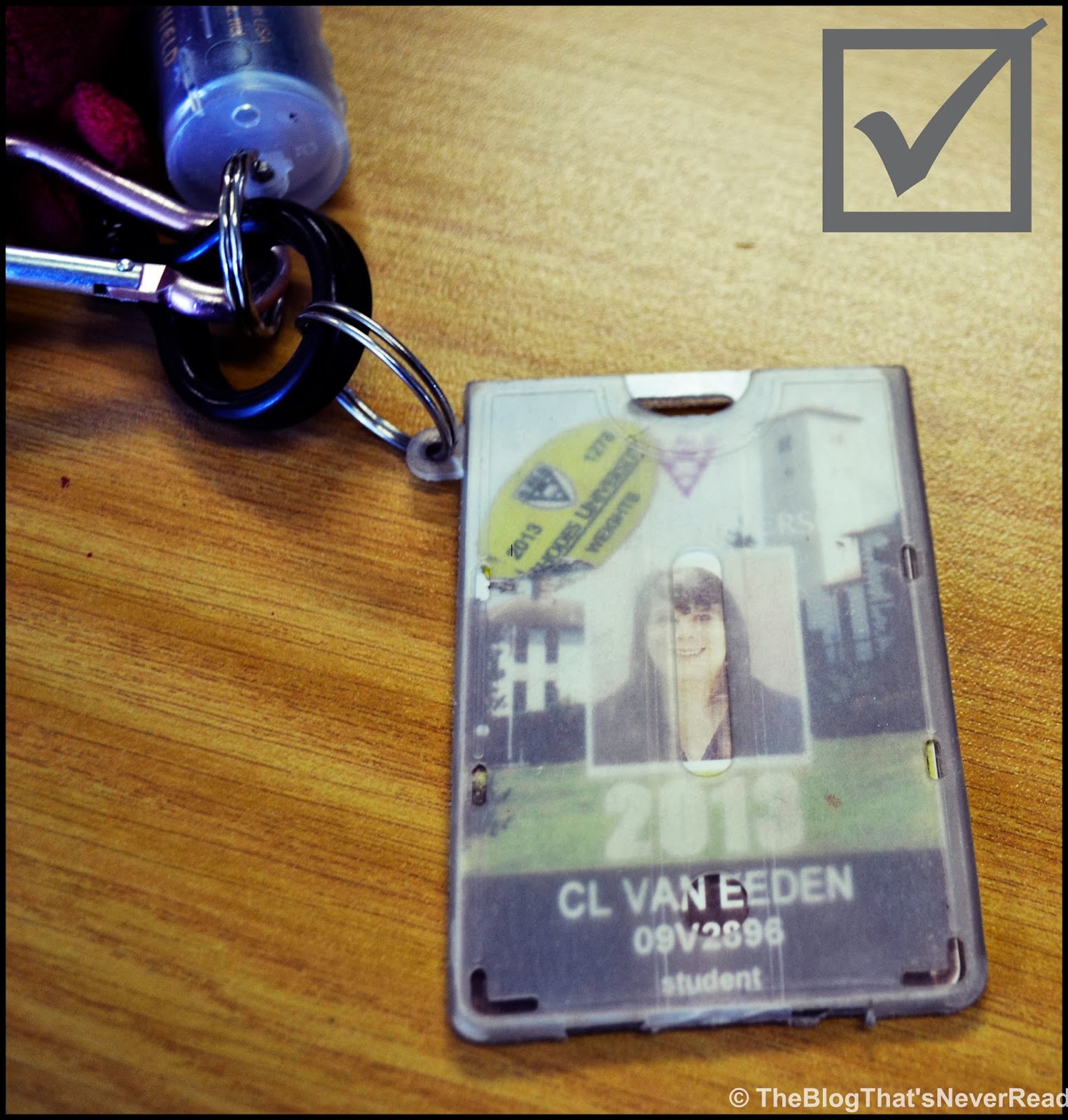
  5. A card holder and lanyard: Some universities supply lanyards and card
    holders as a part of their orientation packs, others don’t. But these two things can be total life savers. You will have a student identity card of some sort that you will most likely need to have on you at all times whilst on campus. These slippery pieces of plastic are incredibly easy to misplace or lose. If you keep yours in a plastic card holder that you can either attach to a bunch of keys or a lanyard that you keep around your neck or in your pocket/bag, you will be less likely to lose your student card. I have put together a list of things that you will definitely need at University/College if you are of the female variety, check it out!
If you have yet to stumble across a general list of things that you should take with you to University, here is a quick one that you can build onto:
  • Bed linen – it’s nice to have your own, even if they supply you with a set 
  • Your clothes, obviously 
  • Bath towels 
  • A kettle, mugs, spoons and tea/coffee (depending on your living situation) 
  • Pens, notebooks and files/folders 
  • A 2014 diary (to keep track of deadlines and test dates)

Tuesday, April 16, 2013

Honey Boo Boo, all that bad?


As a current TV advert states Here Comes Honey Boo Boo is the “show that has divided America” (and the world let’s be honest). And it sure has! People are raging about how common, redneck, lowdown and disgusting the family are. And others are raving about how much they love the show, although I've noticed that not many people say why they love the show.

My opinion: I think Here Comes Honey Boo Boo is a fantastic show, I love it, and here’s why.

Here is a family of people who do not care one little bit about what others think about them. How amazing must it be to love yourself so much that you don’t care about how others perceive you? Should we not all strive towards such self-love? June or Mama, the mother of the family, weighs over 300 pounds and yet she thinks she is beautiful. But according to society’s definition of what is beautiful or desirable, she is not. I think it is amazing that she is so confident in herself and that she thinks she is beautiful no matter what.

Here is a family that is so close that they are comfortable being themselves around one another, to the point where they fart in front of one another, pick their noses, burp etc. Their display of this supposed socially unacceptable behavior around one another just shows how accepting they are of one another. Should we not all want to have relationships that close and that comfortable with our family members?

What I think is most successful about the show is how it highlights a huge problem in the way that we think. Yes, their behavior can be considered as common and lowdown, but according to whom? Yes, their accent is so southern that it is almost impossible to understand, but why do we think that that’s a problem? Yes, it’s gross that they fart, burp and pick their noses on camera, but gross according to whom?

I think what the show highlights most obviously is that we have this belief that our culture is what is right and acceptable, nothing else is. To them they don’t have an accent. That is our perception of them. And just because they don’t talk like we do doesn't make them any less common than the Geordies of Newcastle whose accent we don’t understand either.

Their behavior is perceived as socially unacceptable. But it’s unacceptable according to our culture, to them it’s perfectly normal. We think being that fat is ugly, we think behaving that way is unladylike and rude, we think what they are doing is wrong. We are so quick to make judgement based on the fact that we believe that what we do in our culture is right, and everyone else who doesn't do it our way is wrong, disgusting, controversial.

Monday, March 4, 2013

Depression Checklist for Students | Advice


Sometimes it's tricky to figure out if you're feeling sad or if you're genuinely depressed. Run through the checklist below, it may help. This is something I complied myself, it is not by any means a professional document.

1) Are you not feeling like yourself?
2) As students, we generally don’t have the healthiest eating habits, but have your eating habits changed drastically? Are you eating a lot more or a lot less than usual?
3) Do you find yourself either over-reacting to the smallest things or feeling numb when you should be reacting to big things?
4) Are you lacking motivation lately? Are you finding it difficult to get out of bed in the morning or battling to find the motivation to get things done?
5) Are you sleeping more than usual or than your should be? Or are you finding it difficult to fall asleep or stay asleep? Do the words "I'm too depressed to sleep" make sense to you?
6) Do consequences not matter to you anymore? In other words, do you care if you miss an important class or not?
7) Are you more homesick than usual? Most students who are studying away from home experience homesickness at some point and some more than others, but are you missing home or your parents a lot more?
8) Do you feel like other people won’t/don’t understand what you’re feeling?
9) Do you feel isolated and alone?
10) Do you sometimes feel like you just can't do this thing called life?
11) Are you turning to alcohol, drugs or other substances to help you to forget about how you’re feeling or numb yourself?

If you've answered yes to a lot of the things above, you might be experiencing depression. It may be serious or it may be temporary. Depression can be caused by so many things and it’s important to know that a lot people suffer from depression every day...your problem is not unusual and you are not alone - as cliche as that may sound.


So what can you do?


  • Fight! Don’t give in. I know it’s easier said than done, but find the strength within yourself to hold on.
  • Seek help. Whether it be making an appointment at your campus counselling centre or seeing a private psychologist, there is help out there! You may not think that therapy is for you or you may be totally opposed to it. That’s okay too.
  • Talk to someone. If you’re not into  going for some therapy, try to find a friend, family member or even a teacher to talk to. Sometimes opening up to someone and being heard can help in the biggest way. And don’t give up if you have a bad experience the first time you talk to someone.
  • Look for support. Actively searching for support and information on online forums and communities can make you feel a whole lot better. MDJunction is a really great place to find support!
  • Get active! Getting some exercise can do you a world of good. Getting those endorphins pumping will immediately feel happier. Go for a walk or a swim, play a game of tennis...anything that gets you moving and out of the confines of your bedroom.
  • Make a list of things that you usually make you happy or that made you happy when you were a kid and do them! Whether it be baking, building puzzles, going to the beach, going out dancing, hiking, gardening, shopping, painting, volunteering etc.


Thursday, February 14, 2013

A first year's guide to failing | How To

In South Africa, it is that time of year where the lucky 1 percent of our country is experiencing the start of a crucial life experience: their first year of University. As someone who has "been there, done that" I have some valuable tips that may help you in your (most probably unintentional) feat to fail your first year.


**WARNING: this post may contain dangerous amounts of sarcasm. Please proceed with caution.

Credit to Gabriella
  1. Don’t go to lectures/classes. Rely solely on what’s in your store-bought textbook, on the internet or in your friend’s notes.
  2. If you do go to lectures/classes, try to sleep through them as much as possible. That way you’re catching up on enough sleep to complete steps 3 & 4
  3. Party every single Friday, Saturday and student special night.
  4. Stay up all night watching movies, TV or on tumblr. Don't be disciplined. Self-government is a pointless thing to learn anyway. 
  5. Get high a lot. And make friends with people who get high a lot.
  6. Get addicted to something that costs the majority (if not all) of your allowance.
  7. Only study the night before or even the morning of big tests and exams
  8. Never go the extra mile, only to the bare minimum. Meeting sub-minimum requirements is all that matters.
  9. Rely on that one really nice friend of yours to take notes for you in class and use them for their study notes too...don’t worry, they won’t drop you just before exams.
  10. Blame your crappy marks on everything and everyone but yourself. Being honest never gets you anywhere.
  11. Definitely don’t try to find a balance between academics and the rest of your life.
  12. Focus solely on how many days are left until vacation and how homesick you are.
  13. Occupy yourself with impressing the opposite sex. You need to spend at least 70% of your week doing this.
  14. Oh, wait! You need to spend at least 70% of your week wasted. Or high. Or both. Preferably both.
  15. Do not, under any circumstances, spend any amount of time on trying to grasp time management  prioritisation or goal setting.
  16. Mal-nourishment is fiiiine! You need the money for booze anyway.
  17. Do not motivate yourself. Ever. And don’t spend any time trying to figure out how to motivate yourself because, like I said, you never need to motivate yourself. And don’t befriend people who are self-motivated. Stay far away from them...they might just influence you.
  18. Never be proactive. Complacency is key. No one likes driven people anyway.
  19. Sleep around. As much as possible. STDs and STIs are so rare. And date rape is obsolete. And getting a reputation on campus will have no affect on your academics.
  20. And lastly, do not have the willingness to learn.


Sunday, January 27, 2013

How to Bleach Your Nails | How To


Often using cheap nail polish (which is all I use), wearing false nails or working with food lead to yellow nails. A lot of people choose to carry on painting the nails so that the yellow isn't visible but I have found that the best thing to do is to bleach them first and get them back to their healthy colour before painting them again. Here are a few ways that you can try to bleach your nails:

Lemon:
Cut a ripe lemon into wedges and rub them on your nail bed for about 5-10 minutes. If you have cracked or raw cuticles, try to avoid getting the lemon juice on them as it will sting like crazy! If you don’t have fresh lemons you can use lemon juice in hot water and soak your nails for about 10 minutes. I find that fresh lemon works best.


Whitening Toothpaste:
Coat each nail with a thick layer of whitening toothpaste and leave it on until it dries. Then take a nail brush and some hot water and scrub it off.


Clean your house:
This may seem like an arbitrary concept, but the next time you’re cleaning or doing the dishes, leave the rubber gloves off. The bleach in your cleaning products will help to lift the stains. But be careful, household cleaning products can also weaken your nails and damage your skin – so don’t overdo it!

Why I haven't/won't Read Fifty Shades of Grey | Opinion


Throughout last year the Fifty Shades of Grey trilogy was all the rage. And it has clearly continued into 2013. There are still shamelessly large displays of hundreds of copies of the novels at the front doors of bookstores and thousands of people are still buying the book/s everyday. I often get asked if I've read the book or the trilogy yet and when I answer that I haven’t, people always want to know why. Most of the time I've just said that it’s a long story and people have accepted that. But I had quite an interesting conversation with a friend of mine the other day where we both deconstructed why we don’t like the books and also why we don’t like getting into it with other people.

WARNING, this is a very long explanation and if you’d prefer a quick summary, scroll to the end of this post.

I think that a lot of people think that I don’t/haven’t read the books because I don’t like the sexual content and that’s not it at all. A lot of really good books have had detailed sex scenes in them. Personally, I don’t think there is anything wrong with reading about sex. Here’s why I really have no regard for the Fifty Shades of Grey Trilogy:

I have read the first two pages of the first book, Fifty Shades of Grey simply because my friend had the e-book open on her laptop and I could not curb my curiosity. And in those first two pages alone I experienced the worst possible level of writing I have ever read in a published text. I understand that the book is meant to reflect the character’s own thought’s and immaturity but to what extent can this be used as an excuse for James’ horrible writing. It’s teaching readers and aspiring writers that that level of writing is okay and could even be published.

Secondly, it is not only bored housewives that have become so obsessed with the trilogy. I have found that in actual fact, a large part of the readership are teenage girls and young adults who have never experienced sex or even a relationship for themselves. If you have read the book yourself, think about what sorts of lessons it’s teaching people who have never had sex or been in a serious relationship? That it’s normal or okay to be hurt by your sexual partner. Also, it teaches girls that it’s okay if their right to say no is ignored. It’s teaching girls that even if they are uncomfortable with what someone is doing to them, they should keep quiet and enjoy it.

What I disagree with most is that there is no positive message or moral to the story at the end. A few people who have read the first book have told me that there is no resolution to the story. I have no idea if by the end of the trilogy there is a ‘happy ending’ so please excuse my ignorance. What I mean by a happy ending is that in most books where woman are in screwed up relationships much like the one in Fifty Shades, they are usually able to escape them and are stronger people by the end. What I am trying to say in this poorly written paragraph is that the reader has to sit through these drawn out and highly graphic sex scenes – which they either enjoy or they find utterly nauseating – and there is no positive outcome, there is no point. It in no way empowers or inspires women to get out of their own abusive situations or help their friends out of theirs.

Take series like Harry Potter or Twilight (I am NOT putting them in the same category, relax!) that everyone was/is obsessed with and everyone has read numerous times. The Fifty Shades trilogy is a lot like them in the sense that there is a massive following and a huge fandom, it is being made into a movie and people who never read have read the books over and over again. The Twilight Saga although sometimes amateurly written, had a positive message for the millions of teenage girls who read the Saga and watched the movies.

In Fifty Shades, there is none.

To summarise
 I haven’t/won’t read the books because:
  1. They are horribly written
  2. They are teaching girls all the wrong things
  3. There is no point in suffering through the low level of writing and graphic sex scenes when there is no positive or uplifting message at the end.

Saturday, January 5, 2013

40 songs that got me through 2012


Happy New Year everyone!!! Now that we have said goodbye to 2012, I’m going to share with you the songs that got me through the year. You know when you're having a really crappy day and there's that one song that instantly makes you feel better? Or that one song that holds so many good memories? That one song that just speaks to your life? Here they are my top 40 tracks for 2012 in no particular order:

  1. Shut Up – Euphonik (this is an awesome house track by a South African DJ which you probably won’t get unless you’re South African)
  2. Persuit of Happiness (Steve Aoki Remix) – Kid Cudi ft. MGMT and Ratatat
  3. Make It Bun Dem – Skrillex ft. Damian Marley
  4. Rattle – Bingo Players
  5. Kill the DJ – Green Day
  6. Da One – Rihanna
  7. You Are Not a Robot – Hoodie Allen
  8. Sail – Awol Nation
  9. Kill Your Heroes – Awol Nation
  10. Take Me Away – Chase and Status
  11. The Rain (Supa Dupa Fly) – Missy Eliot
  12. Roxanne – Police
  13. Rack City – Tyga
  14. Feel the Love – Hoodie Allen
  15. Up and Away – Can’t Stop Won’t Stop ft. June
  16. Shak Out – The Mouse Outfit ft. Sparkz
  17. Diamonds – Rihanna
  18. No Interruption – Hoodie Allen
  19. Heavenly Sent – Micasa
  20. Kick the Baby – Klynch
  21. Toys for Boys – Can’t Stop Won’t Stop
  22. I Slept With Someone In Fall Out Boy and All I Got Was This Stupid Song Written About Me – Fall OutBoy
  23. Sugar, We’re Going Down – Fall Out Boy
  24. Every Teardrop is a Waterfall – Cold Play
  25. We Found Love – Rihanna
  26. Dance, Dance – Fall Out Boy
  27. Our Lawyer Made Us Change The Name Of This Song So We Wouldn't Get Sued – Fall Out Boy
  28. Don't you Worry Child - Swedish House Mafia
  29. No Beef – Afrojack ft. Steve Aoki
  30. When I Wake Up – Jesse Clegg
  31. Golden – Fall Out Boy
  32. I'm Like A Lawyer With The Way I'm Always Trying To Get You Off (Me & You) – Fall Out Boy
  33. The (After) Life of the Party – Fall Out Boy
  34. Hum Hallelujah – Fall Out Boy
  35. Changes – 3 Doors Down
  36. Paradise – Cold Play
  37. Princess of China – Cold Play ft. Rihanna
  38. Jesus of Suburbia – Green Day
  39. Don’t Stay – Linkin Park
  40. Talking to the Moon – Bruno Mars

Thursday, November 29, 2012

How to Make Plunger Coffee | How To

I recently bought my very own coffee plunger (also called a french press). I have never been very good at making coffee and it certainly took numerous tries for me to get the hang of making plunger coffee. I watched a few YouTube videos and tried a few different ways and here's what I have found to work best:

1) Make sure both the glass jug and the filter part are completely clean.

2) Boil your kettle and fill the jug with the boiling water for about a minute so that the glass warms up (this way your coffee won't get cold whilst it brews and it prevents the glass from cracking).

3) Empty the boiling water out and then scoop your coffee granules into the jug. I heaped table spoon per cup usually works well. If you like your coffee a bit stronger than add more.  I chose a medium roast called Confessions - but of course this is up to you. There are some great specialised coffee brands but generally whatever you can get at a supermarket is great too.

4) Boil your kettle again and allow the water to cool for about a minute (pouring boiling water directly onto the powder burns it) and then pour enough into the jug to just cover your coffee and then stir well. You will see foam forming.

5) Then fill to the top of the jug, leaving at least 2cm space at the top. If you are unsure how full to make it, pour the water into your mug first and then into the plunger to measure it out exactly.

6) Place the filter (lid) onto the jug (without pushing the plunger down) and turn it so that the nozzle is closed.

7) Usually there are instructions on the coffee packet as to how long you should leave the coffee to brew, but the general rule is 3 - 4 minutes so keep an eye on the time!


8) Fill your mug/s with milk (hot or cold) and then pour your freshly brewed coffee whilst stirring. Add sugar to taste.

Enjoy!!!

Monday, November 26, 2012

5 Tips for Kicking Exam Stress' Butt | Advice

Most institutions place a huge emphasis on exams. This puts students under an immense amount of pressure which more than likely amounts to a great deal of stress. Stress is one of the most counterproductive things when it comes to exams: it prevents one from thinking clearly and retaining information. It results in constant fatigue and people often develop unhealthy habits as a result of stress. As someone who gets really stressed when it comes to exams, here are my tips to deal with and even combat exam stress:


1) Get enough sleep. Establish a set bedtime and make sure you stick to it and make sure you get a full 8 hours (if not more). Both your brain and your body need sleep in order to process and retain information, to cope with stress and to help you concentrate.
2) Exercise. Although working out or playing a sport does cut into your study time, setting aside an hour a day to get moving will actually benefit you more than studying for that hour. The reason being is that it floods your body with oxygen and gets your blood pumping. When exercising you can get all your frustration out and it helps hugely with keeping stress levels at bay.

3) Avoid stressful people. As mentioned in my previous post about exams, staying away from people who stress a lot is just as important as avoiding negative people. People who naturally stress a lot will have an influence on the way you function. Their stress levels will rub off on you.

4) Stay healthy. One tends to pick on a lot of sugary and unhealthy food during exams - mostly because of stress and the need for energy. Treat your body respectfully and it will return the favour. Try to eat at least one proper meal a day that includes a high dose of protein and a load of different veggies. Eating balanced meals will help your body cope with stress and keep you feeling healthy.

5) It's mind over matter: think your way out of stress. If you stress at a particular time during exams (e.g. the night before an exam , the day of or even right at the beginning of your studying) then make sure you prepare yourself to mentally combat your own stress. This might sound really wishy-washy, but you do have the power to control your own thoughts. When stressful thoughts cross your mind, distract yourself, think about calming things and convince yourself - even if it may not be the truth - that you are well-prepared and that you have more than enough time to get everything into your head.

GOOD LUCK!!!

Sunday, November 18, 2012

My favourite things in life

I love stars. I love Summer. I love food. I love pink. I love pizza. I love swimming. I love amusement parks. I love the beach. I love technology. I love art. I love reading. I love baking. I love sleep. I love coffee. I love music. I love lava lamps. I love milkshakes. I love board games. I love magazines. I love nail art. I love photography. I love rings. I love expensive cars. I love dogs. I love boots. I love stuffed toys. I love chocolate. I love postcards.I love vloggers. I love The Italian Job. I love shopping. I love puzzles. I love non-fiction. I love perfume. I love spiral-bound books. I love Cape Town. I love YouTube. I love licking the spoon. I love goldfish. I love sarcasm. I love making big decisions. I love ice-cream. I love make-up. I love PJs. I love nature. I love gym. I love bacon. I love design. I love watches. I love glitter. I love tattoos. I love denim shorts. I love skylines. I love Green Day. I love skateboards. I love guitars. I love snap-backs. I love nail polish.  I love walk-in closets. I love Pop art. I love Birthdays. I love lipstick. I love hoodies. I love bows. I love Modern Family. I love knuckle rings. I love piercings. I love Fall Out Boy. I love doughnuts. I love kids. I love Nutella. I love platform heels. I love Dr. Zeus. I love Pacman. I love Henna. I love cheese. I love ombre hair. I love welcome mats. I love boys who wear snap back caps. I love elephants. I love comic books. I love cupcakes. I love pot plants. I love vodka. I love messy buns. I love liquid eyeliner. I love boys who wear jewelry  I love soda floats. I love tiaras. I love unicorns. I love Sam Pepper. I love Instagram. I love lollipops. I love facials. I love card games. I love earning money. I love concerts. I love stationary. I love key rings. I love Converse All Stars. I love learning. I love collages. I love I love Ivy League Universities. I love your mom. I love Christmas. I love social networking. I love yoga. I love bubble bath. I love brightly-coloured hair. I love waferer sunglasses. I love holidays. I love Tumblr. I love getting mail. I love boys who wear hoodies. I love typewriters. I love soup. I love Disney movies. I love swings. I love Jacksgap. I love genuine people. I love my University. I love skinny jeans.

Friday, August 10, 2012

10 Tips for Interviews | Advice

We're all going to have to attend an interview at some point in our lives, whether it be to get into College/University, for Postgraduate funding or, more commonly, for a job. So here are some tips (in no particular order) to guide you in the right direction, and to help you avoid any awkward moments!


1) Take a bottle of water into the interview. Personally, I find that because of the nerves and the fact that you will be talking a lot can result in a dry mouth or throat which makes talking a bit difficult. Take bottled water (not a sports bottle), unopened and make sure it's not scruffy (i.e. the label peeling off etc.). Oh! And make sure it's not carbonated (sparkling) water - this might end really badly! 

2) PREPARE! This is perhaps the most important tip of them all. Find as much information as you can about the job that you are applying for (you can get this from their website/facebook page, brochures or from graduate guides) so that you can give well-informed answers in the interview. Read over your CV and your motivation letter/application form before going into the interview to refresh your memory. Also, if you can get hold of the job profile/description for the position that you're applying for, make sure you're familiar with it too.

3) When you get to the venue where you will be interviewed and once you have greeted the interviewer/s, ask if you may be seated. Do not simply sit down. This demonstrates respect and makes sure that you avoid the awkwardness if you sit in the wrong place.

4) Do not eat anything with garlic or onions in it for at least 24 hours before the interview. You don't want to have bad breath - and sometimes brushing your teeth isn't enough. Also, if you are a smoker, I would suggest that you don't smoke before the interview, so that you don't go in smelling like smoke. And on the topic of smells, make sure that you don't overdo the perfume/cologne - there's nothing worse than smelling someone before they even enter the room.

5) I'm pretty sure that this is a given, but make sure you dress appropriately. Formal is always the best option. Make sure that your outfit is not too revealing. But also make sure that you are comfortable so that you will relax in the interview rather than worrying about the blister that your shoes are giving you. Ladies, I would avoid heels - formal flats are best - this ensures that you won't trip over anything or twist your ankle.

6) If you are offered a sweet or breath mint at any point during the interview, decline the offer politely. Having a sweet in your mouth will make talking very difficult.

7) If you are nervous (well, if isn't exactly accurate - you are human, you will be nervous!), SAY SO. When the interviewer asks you how you are say "I'm good thank you, just a bit nervous". This breaks the ice a bit and honesty goes a long way.

8) Think before you answer questions. Even if you spend an entire minute in silence thinking through your answer. I have learned from experience that diving into your answers too quickly often results in you losing your train of thought and rambling or repeating yourself. As I mentioned before, having a bottle of water with you means you can take a sip and think about your answer without sitting there awkwardly.

9) Once the interviewer/s has finished asking you questions, it is possible that they will ask you if there is anything you would like to add. Play this one carefully. Adding to what you've already said can make you seem unconfident in the answers you have already given. I suggest rather, that you say "I think I have covered everything". If there is something you need to add, do so briefly...it's a bit late at this point to try to sell yourself.

10) And finally, walk out of the interview confidently. Shake the interviewer's hand (unless there are more than three people interviewing you - then this becomes an awkward moment), thank them for their time and walk out with your head held high. Even if you're feeling like it didn't go so well.

Monday, June 18, 2012

How to do well in College/University | Advice

It's quite straightforward really, but harder said than I know...

1) Attend all your lectures

As much as you think they might be useless or boring. Your lecturer will notice that you are a regular and might keep that in mind when marking your assignments/exams and they are the majority of what your exams are based on.

2) Attend all tutorials or extra classes

Sometimes just showing face can get you far in life. And you never know when you might just be rewarded for your efforts!

3) Ask for help - but prove that you can be helped

Although asking for help can be embarassing sometimes, there are going to be things that you don't understand or can't quite grasp. This does not mean you are stupid. Often asking for help shows that you are invested and that you are willing to go the extra mile. Ask a friend who takes the same class, a tutor or your lecturer. No question is a stupid question, and if anyone implies that it is, report them. It is always a good idea to go into whatever meeting you've made to get help prepared. Make sure you know exactly what you are going to ask and be able to prove that you have already tried to help yourself by doing research, extra readings and so on.

4) Hand your work in on time

Handing work in late purely because of poor time management will certainly jeapordise your marks.

5) Work consistently

Keep up with your work during term so that you don't spend all your time trying to catch up work an understand things that you haven't gotten around to yet when it is actually time to be studying. When exams come around you want to be spending time on revising what you already know.

6) Go the extra mile

If there are assignments that you can do for extra credit or if your lecturer has recommended extra readings - do them! Always strive to better yourself and build upon what you already know.

Wednesday, June 13, 2012

Great Website for Academic Advice

Hi all :)

I have discovered a fantastic website for academic tips, especially for College/University called academictips.org It covers everything from time management to note taking and how to manage your money as a student. This is a great source of information particularly if you are going to be starting College/Varsity soon or if you are going to start applying in the near future...it even gives you advice for writing entrance essays. I just thought I would share this useful site that I stumbled upon...enjoy!

**Click here to visit the website

Wednesday, June 6, 2012

A College/University Student's Guide To Surviving Exams | How To

I have officially survived 3 years of University level exams and I'm about to go in for the 4th year. I have learned a lot along the way. This advice is not the usual: exercise, eat healthily etc. etc. That doesn't necessarily work for everyone. But here are some things that I have found to really help:


1) Drink PLENTY of water. 
They say 8 glasses per day. They also say 1 glass per 10kgs that you weigh. My opinion is drink as much as you can handle. If your bladder is anything like mine, you will need the bathroom pretty often. But keep in mind that it is flushing out all those nasty toxins that get in the way of your brain absorbing information. Also, for those of you who write exams in the middle of Summer, it's important to keep hydrated.

2) Stay away from people who will bring you down.
When you're studying (or cramming...let's be realistic), you want to stay as self-motivated as possible. You also want to feel confident in your own knowledge and abilities. Being around people who complain and are mostly negative about exams will not help you. Rather surround yourself with people who are willing to work just as hard as you are. That way you will have positive influences around you to guide you when you are feeling discouraged. When people are going through things together, they tend to adopt a common attitude.

3) Take a break after every exam.
Even if your exam timetable sucks and you have all your subjects in a row, it really helps to take a break after every paper. After sitting an exam (whether it be an hour long or 5 hours long), your brain, body and even your soul needs time to recouperate before you hit the books again. Most of the time I would recommend having a decent nap. But if you are too scared that you won't wake up fresh enough to carry on studying, do something that requires little energy. If you have 2 exams in the same day, go for a quick walk or have some lunch etc.

4) Always set more than one alarm!
Experience has taught me that even if you are the most responsible person in the world when it comes to exams, there is always the chance that something goes wrong. If you usually use your alarm on your phone, make sure that it is fully charged before you hit the sack. BUT, do yourself a favour and invest in a good old-fashioned alarm clock (they are not very expensive these days) that you can keep at your bedside. At least you will be gaurenteed to wake up. You don't ever want to be in a position where you have to explain to your Head of Department that you slept through your exam.

5) If you are addicted to something that helps you procrastinate, get someone to keep it from you during exams.
If you're anything like me, you can sit for hours watching endless YouTube videos and playing Tetris on Facebook. If you find yourself spending too much time doing these things when you should actually be settling down to study, get a friend to keep your laptop for you during the time that you have set aside to study. I'm not saying starve yourself of your luxuries. But get to know your own habits and identify where you waste the most of your time.

Monday, May 14, 2012

How to Write an Academic Essay | How To

Now that I am in my 4th year at varsity, I have realised that writing essays is no easy task - no matter how many of them you write. Each one is a new challenge and requires different techniques in order to answer the question or cover the topic effectively. Of course each Department/Faculty/subject will require different formats or styles of writing, but here are some general hints and tips that might help to guide you in your writing.

1) Make sure that you fully understand the task. 

In other words, make sure you know what the word count/page count should be, when it is due, what style of referencing is required and so on.

2) Read the question or topic numerous times.

...even if it is really short. Often people write entire essays without having answered the question or topic at all because they haven't read and understood the question properly. If there are parts of the question or words that you do not understand, Google them or speak to your lecturer or tutor for clarification. 

3) Breakdown your question. 

The longer you take a class/subject, the more complex the questions become. If there are numerous things which you need to compare, contrast, discuss or analyse and if you have sub-topics which you need to include then divide your question up (in point form) accordingly so that you do enough research to cover each point.

3) Work backwards! 

This is a technique that I only began using this year, but it works so well and helps you manage your time efficiently so that you don't miss the deadline or hand in something that isn't finished. How this works is you write down everything you need to do for the essay from last to first. So for example, the last thing you will need to do is submit it/hand it in, the second last is print it, the third last will be to proof read and edit, the fourth last is your bibliography and so on right up until the first thing which will be to choose your topic or to begin researching it. Then you write it out in order (from first to last) and divide it up into days. So you say  on Monday I want to choose my topic and begin researching it. On Tuesday I want to get books out of the library and read them. On Wednesday I want to finish reading the books and then get journal articles and so on. Make it into a checklist so that you can make sure you have completed your tasks towards the essay each day and if you don't finish what you have planned for that day then you can move it to the next day.

**NOTE:  For a lot of people (I am one of them), the pressure of leaving things until the last minute actually means that they will produce of a higher standard, but even if this is the case, plan backwards so that you at least have all your research done and you are ready to write at the last minute. You don't want to still be looking for information to write about the night before!

4) Do your reading.

For me, this is what takes the longest when writing an essay. Once you've read everything you need to write about then writing flows quickly. If your writing takes you longer than it does for you to read, then allot more time in your backwards planning for writing rather than reading. It depends on how you work.

5) Plan your essay. 

If you have read sufficiently, your planning will be easy because you will already know what you want to say. Lay your planning out in headings and then include points underneath, for example:
  • Introduction
          - Introduce topic and lay out aims for essay
          - Introduce argument
          - Define problem
  • First Paragraph: Social Theory
          - Define theory
          - Explain theory
          - Place theory in context
          - Apply theory to case study.

I  never used to plan my essays and my thoughts an arguments would never flow properly because my ideas were all over the place.

6) Start writing. 

Make sure you stick to your headings. If you are not allowed to include headings within your essay, delete them in your editing process. They help you to know where you are in the essay - especially if you want to add points to it later.

7) If you get stuck, take a break.

Do something completely unrelated and then come back. This way it will be easier for you to notice mistakes and tighten up your points.

8) PROOF READ! 

I cannot emphasise proofreading enough! Once you have completed your essay, read over it a few times (take a break before you do this). In most cases you will get marks deducted for sloppy presentation and formatting, poor spelling and grammar etc. It does not take long and it will help you in the long run. 

And you're done! :)